Showing posts with label Bur Oak Book. Show all posts

Friday, January 9, 2015

Interview with Tom Rosburg, pt. 2

This spring we’re releasing the second edition of Sylvan T. Runkel and Dean M. Roosa’s Wildflowers and Other Plants of Iowa Wetlands. Botanist Tom Rosburg provided all new photographs for the second edition, as well as some additional text. Here, he talks with Bur Oak Books series editor Holly Carver about how he became a plant photographer.

Holly: What has changed in the outdoor world since your first days of photographing these areas? What’s better, what’s worse?
Tom: One thing is that there are more public areas to go to and look for nature subjects. And at least some of them are still pretty good examples of Iowa’s native landscape. In part this is due to the increased emphasis on restoration work. So access to areas is surely better. On the down side—I see increasing problems with non-native, troublesome plant species that threaten the integrity of natural areas. Unfortunately, in some cases this problem is exacerbated by poorly designed and/or executed restoration work. 

Holly: What advice would you give to younger nature photographers? What are the particular challenges of being a botanical photographer?
Tom: I teach nature photography at Drake University and Lakeside Lab, so there is a lot I could say. In short, I stress three components that make an image aesthetic: 1) understand your equipment and how it works, what to use when, correct exposure is critical; 2) understand the role of content in an image, especially elements of design and light quality; and 3) understand the key features of composition, for example, depth of field, perspective, and viewpoint.

Plants are very accessible, but photographing them can be challenging due to bad light and wind. There are several ways of dealing with these problems with the use of accessory equipment. Or quite often, getting out in the field early in the day can make the difference. There is a lot of truth to the saying “the early photographer gets the image.”

Holly: What are your favorite natural areas in Iowa and the Midwest? What areas do you return to constantly, and what’s your favorite newly visited area?
Tom: The state preserves are generally my favorite areas because they offer the best examples of our native ecosystems. These are the places that provide the best opportunities for plants and landscapes. On a larger scale, both the Loess Hills and Paleozoic Plateau landforms offer exceptional opportunities for nature photography.

Areas close to home are the places I return to repeatedly—Ledges State Park and Doolittle Prairie State Preserve are good examples. A newly visited area that has a lot of promise is Whiterock Conservancy in Guthrie County.


Wednesday, January 7, 2015

Interview with Tom Rosburg

This spring we’re releasing the second edition of Sylvan T. Runkel and Dean M. Roosa’s Wildflowers and Other Plants of Iowa Wetlands. Botanist Tom Rosburg provided all new photographs for the second edition, as well as some additional text. Here, he talks with Bur Oak Books series editor Holly Carver about how he became a plant photographer.

Holly: How long have you been photographing plants?
Tom: I obtained my first 35 mm SLR camera in 1977 as a graduation gift and started doing casual nature photography. In 1986, I switched to Nikon equipment and added several lenses to my gear. That’s when I started pursuing nature photography more seriously and began developing plant photography skills.

Holly: Why have plants kept your photographic attention for so long? What other subjects do you focus on?

Tom: About the same time, in 1986, I began the graduate work that eventually lead to my becoming a botanist. So plants have occupied my interest ever since I began serious photography. There are over 2,000 species of plants in Iowa, so there is a huge list of potential plant subjects to photograph. I’d like to have a photographic record of every one of them. I shoot all nature subjects—landscapes, wildlife, macro subjects as well as plants. Because plants are always available, I tend to gravitate towards them when I am out doing photography and time is limited.

Wednesday, April 9, 2014

Interview with James Sandrock and Jean Prior, pt. 3

James Sandrock and Jean Prior are the authors of The Scientific Nomenclature of Birds in the Upper Midwest, a Bur Oak Guide published just this month. Bur Oak Guides series editor Holly Carver asked them a few questions about the book.

HC: Now that you have mastered the nomenclature of all these species, what new connections among names, behavior, plumage, etc., have you discovered? What was the most intriguing?

JS: It is both interesting and amazing that the binomial system perfected by Linnaeus more than 250 years ago endures to this day, practical, resilient, and valid. As we worked our way through the research and writing of this book, it became more and more evident that the early taxonomists and ornithologists possessed a deep knowledge of classical languages and literatures; the names they assigned to avian genera and species reflect their easy familiarity with classical Greek and Roman myth, history, literature, geography, even geology, as well as with the languages themselves.

It surprised us that not all binomials were helpful; some were misleading, some inaccurate. We found at least one name to be a nonsense word. The genus Xema appears to be such a word concocted by William Elford Leach for the genus of Sabine’s Gull. (More about William Leach later.) Many species names are eponymous, such as henslowii or swainsonii, which do not describe any distinguishing marks of the bird itself—not much help to an observer in the field, but interesting as ornithological history.

Most binomials, however, augment and enhance the description of distinguishing marks. The binomial of the Red-eyed Vireo, for example, is Vireo olivaceus; the specific Latin term is a descriptive adjective that calls our attention to the olive-green plumage of this small bird. While the common name focuses on the red irises of this species, the Latin binomial affords the observer another important distinguishing mark to look for when identifying it.

These examples and many more served throughout this enterprise to deepen our interest in and appreciation of scientific nomenclature.

JP: I can’t say that I have mastered the nomenclature of these species, but I certainly learned a lot working alongside Jim. His special background for this enterprise awakened new insights into language, history, biology, art, and literature. Though Aristotle, Pliny, Nuttall, and Newberry were familiar names from other scientific studies, I found their contributions and connections to the naming of birds to be quite fascinating.

I was responsible for including the regional or folk names for these birds, and I found they often were more useful than the attributes provided by the scientific name or even the common name. Wilson’s Warbler, for example: Alexander Wilson was a remarkable scientist, writer, poet, and painter, but his name alone is not as descriptive and helpful as the regional name “black-capped warbler.”

Other useful, colorful, or humorous names include “thunder pumper,” “bog bull,” and “look-up,” which tells you a lot about the sound, location, and demeanor of an American Bittern. “High hole” and “yarrup” suggest where to look for the nest of a Northern Flicker and what to listen for. “Golden slippers” takes your eye to the feet of the Snowy Egret for a positive identification. Coming upon a “hang-nest” suggests the “hammock-bird,” the characteristic suspended home of the familiar Baltimore Oriole. The tree trunk antics of a “topsy-turvy-bird” help confirm both the White-breasted Nuthatch and the Red-breasted Nuthatch. But be careful, “fly-up-the creek” can apply to both the Belted Kingfisher and the Green Heron.

HC: What were the quirkiest factoids that you discovered?

JS: Two quirky things come to mind. The name of the Slovenian Ornithological Association (OAI) is IXOBRYCHUS, which is the genus of the Least Bittern. And the quirkiest? William Elford Leach (see above), a British zoologist, named many genera and species that occur under, on, and over the sea. While the numbers vary, it is said that he used anagrams of the name “Caroline” possibly thirteen times in scientific binomials. The identity of “Caroline” remains unknown.


JP: One of the quirkiest bits of information was that accompanying the ordinary and common European Starling. It seems that this bird from Europe was first released in Central Park, New York City, in 1890 and 1891 by a Eugene Schiefflin, a great fan of William Shakespeare and also president of the American Acclimatization Society. A goal of this group was to introduce all the bird species mentioned in the works of Shakespeare to New York’s public parks. The group’s greatest success was the European Starling (see Henry IV, part 1).

JS: Thanks for the interview. We think that our book will be both helpful to birders and interesting on many fronts. It has been described as both scholarly and quirky. We hope its readers will find it to be all these things.

Featured Birds
American Goldfinch (Spinus tristis)
Spinus: This is a Latin form of the Greek word spinos, which was Aristotle's word for "a small, finch-like bird."
tristis: The Latin word for "mournful, sad" refers to the long, soft, sweet song, which Linnaeus apparently perceived as mournful.
Common Name: American Goldfinch, which distinguishes this species from the Eurasian Goldfinch (Carduelis carduelis)
Other Names: wild canary, thistle bird, yellowbird

Eurasian Collared-Dove (Streptopelia decaocto)
Streptopelia: From Greek streptos = collar, necklace + peleia = a kind of dove or pigeon. "Collared dove" alludes to the small black and buff "scarf" on the nape of the adult.
decaocto: From the Latin prefix deca = ten (decem) + octo = eight. Several sources cite the Greek myth in which Decaocto (meaning "Eighteen"), a lovely handmaiden, prayed for release from her cheerless existence. The gods obligingly changed her into a dove. The call of this species is supposedly a version of her name, although perhaps not recognizable.
Common Name: Eurasian Collared-Dove, introduced to the United States from its native Eurasia
Other Names: None found

Wednesday, April 2, 2014

Hot off the Press: THE SCIENTIFIC NOMENCLATURE OF BIRDS IN THE UPPERMIDWEST

The University of Iowa Press is proud to announce the release of our newest Bur Oak Guide, The Scientific Nomenclature of Birds in the Upper Midwest, by James Sandrock and Jean C. Prior!
Praise
"Bird enthusiasts now have a simple, informative text to enhance our enjoyment. Whether we are in the field or reflecting on a favorite bird moment, Sandrock and Prior add another facet to expand our knowledge and increase appreciation for birds in our lives."—Neil P. Bernstein, Mount Mercy University

"In this well-organized guide, Sandrock and Prior provide concise descriptions of the origin of scientific and common names of birds in the Upper Midwest. The authors show clearly how the scientific names are based on the color, body shape, or other characteristics of each species. Moving beyond identification, this book opens a new level of understanding for those who enjoy birds."—James J. Dinsmore, author, A Country So Full of Game

Wednesday, December 11, 2013

Give an Iowa Cookbook this Season!

Still holiday shopping? The University of Iowa Press is currently holding our annual holiday sale. We've got great books covering a wide range of topics and interests for up to 65% off. Buy some for your loved ones or buy some for yourself!

Here are just a few of the books that are on sale now…

Gardening the Amana Way
by Lawrence L. Rettig
Bur Oak Book

As a child of parents who were part of the communal life of the Amana Society, Larry Rettig pays homage to the Amana gardening tradition and extends it into the twenty-first century and extends his gardening advice into the kitchen. He shares family recipes for radish salad, dumpling soup, Amana pickled ham, apple bread, and more!

Regular Price: $27.50
Sale Price: $15.00

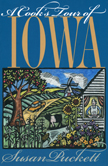
A Cook's Tour of Iowa
by Susan Puckett
Bur Oak Book

"This book may shock the food snobs of America because Iowa's down-home cuisine is not dull after all."--Des Moines Register

"…a combination oral history and cookbook which should delight aficionados of Americana."--Cookbook Digest

"Puckett tapped into the culture of America's Middle West and the result is a book that will give Iowans cause for pride."--World of Cookbooks

Regular Price: $23.00
Sale Price: $5.00

Monday, December 9, 2013

Bur Oak Books for Readers of All Ages -- On Sale!

If you missed (or avoided) Black Friday and Cyber Monday but still need some great gifts, check out the University of Iowa Press's holiday sale! Find great books for up to 65% for all of the readers in your life.

Here are just a few of the books included…

Where Do Birds Live?
by Claudia McGehee
Bur Oak Blog

"An an artist and a nature enthusiast, I am completely enthralled by Where Do Birds Live? Beauty is everywhere if one only slows down to look for it. This lovely book is a good reminder of that."--Stan Fellows, illustrator, The Cuckoo's Haiku and Other Birding Poems

Regular Price: $17.95
Sale Price: $8.00

illustrated by James F. Landenberger
essays by Dean M. Roosa, Jon W. Stravers, Bruce Ehresman, and Rich Patterson
Bur Oak Book

"To pioneer homesteaders, a hawk in the sky was reason to reach for a gun. Now, with out better understanding of the raptors' ecological importance and of their perilous future, a wheeling red tail against the sun is something to cherish, not kill. In The Raptors of Iowa, artist and authors have given to all who are interested in midwestern birds a book that will set the standard for years to come."--J. Fenwick Lansdowne

Regular Price: $29.95
Sale Price: $14.00

Happy shopping!