Showing posts with label Bur Oak guide. Show all posts

Wednesday, January 14, 2015

Bur Oak Books—Call for Proposals

Readers of this blog know that we’re in love with the natural beauty and diversity of the Midwest, and we’re devoted to its human history as well. Many of the books, recipes, and photographs we feature here come from our Bur Oaks Books series and our Bur Oak Guides.

And we’re always looking for new book projects on the natural and cultural history of Iowa and the upper Midwest. If you’ve got a manuscript in the works in this area, please consider the University of Iowa Press as a publisher. You can find more information about what kind of projects we are interested in and proposal guidelines on our website.

Thanks!

Wednesday, April 9, 2014

Interview with James Sandrock and Jean Prior, pt. 3

James Sandrock and Jean Prior are the authors of The Scientific Nomenclature of Birds in the Upper Midwest, a Bur Oak Guide published just this month. Bur Oak Guides series editor Holly Carver asked them a few questions about the book.

HC: Now that you have mastered the nomenclature of all these species, what new connections among names, behavior, plumage, etc., have you discovered? What was the most intriguing?

JS: It is both interesting and amazing that the binomial system perfected by Linnaeus more than 250 years ago endures to this day, practical, resilient, and valid. As we worked our way through the research and writing of this book, it became more and more evident that the early taxonomists and ornithologists possessed a deep knowledge of classical languages and literatures; the names they assigned to avian genera and species reflect their easy familiarity with classical Greek and Roman myth, history, literature, geography, even geology, as well as with the languages themselves.

It surprised us that not all binomials were helpful; some were misleading, some inaccurate. We found at least one name to be a nonsense word. The genus Xema appears to be such a word concocted by William Elford Leach for the genus of Sabine’s Gull. (More about William Leach later.) Many species names are eponymous, such as henslowii or swainsonii, which do not describe any distinguishing marks of the bird itself—not much help to an observer in the field, but interesting as ornithological history.

Most binomials, however, augment and enhance the description of distinguishing marks. The binomial of the Red-eyed Vireo, for example, is Vireo olivaceus; the specific Latin term is a descriptive adjective that calls our attention to the olive-green plumage of this small bird. While the common name focuses on the red irises of this species, the Latin binomial affords the observer another important distinguishing mark to look for when identifying it.

These examples and many more served throughout this enterprise to deepen our interest in and appreciation of scientific nomenclature.

JP: I can’t say that I have mastered the nomenclature of these species, but I certainly learned a lot working alongside Jim. His special background for this enterprise awakened new insights into language, history, biology, art, and literature. Though Aristotle, Pliny, Nuttall, and Newberry were familiar names from other scientific studies, I found their contributions and connections to the naming of birds to be quite fascinating.

I was responsible for including the regional or folk names for these birds, and I found they often were more useful than the attributes provided by the scientific name or even the common name. Wilson’s Warbler, for example: Alexander Wilson was a remarkable scientist, writer, poet, and painter, but his name alone is not as descriptive and helpful as the regional name “black-capped warbler.”

Other useful, colorful, or humorous names include “thunder pumper,” “bog bull,” and “look-up,” which tells you a lot about the sound, location, and demeanor of an American Bittern. “High hole” and “yarrup” suggest where to look for the nest of a Northern Flicker and what to listen for. “Golden slippers” takes your eye to the feet of the Snowy Egret for a positive identification. Coming upon a “hang-nest” suggests the “hammock-bird,” the characteristic suspended home of the familiar Baltimore Oriole. The tree trunk antics of a “topsy-turvy-bird” help confirm both the White-breasted Nuthatch and the Red-breasted Nuthatch. But be careful, “fly-up-the creek” can apply to both the Belted Kingfisher and the Green Heron.

HC: What were the quirkiest factoids that you discovered?

JS: Two quirky things come to mind. The name of the Slovenian Ornithological Association (OAI) is IXOBRYCHUS, which is the genus of the Least Bittern. And the quirkiest? William Elford Leach (see above), a British zoologist, named many genera and species that occur under, on, and over the sea. While the numbers vary, it is said that he used anagrams of the name “Caroline” possibly thirteen times in scientific binomials. The identity of “Caroline” remains unknown.


JP: One of the quirkiest bits of information was that accompanying the ordinary and common European Starling. It seems that this bird from Europe was first released in Central Park, New York City, in 1890 and 1891 by a Eugene Schiefflin, a great fan of William Shakespeare and also president of the American Acclimatization Society. A goal of this group was to introduce all the bird species mentioned in the works of Shakespeare to New York’s public parks. The group’s greatest success was the European Starling (see Henry IV, part 1).

JS: Thanks for the interview. We think that our book will be both helpful to birders and interesting on many fronts. It has been described as both scholarly and quirky. We hope its readers will find it to be all these things.

Featured Birds
American Goldfinch (Spinus tristis)
Spinus: This is a Latin form of the Greek word spinos, which was Aristotle's word for "a small, finch-like bird."
tristis: The Latin word for "mournful, sad" refers to the long, soft, sweet song, which Linnaeus apparently perceived as mournful.
Common Name: American Goldfinch, which distinguishes this species from the Eurasian Goldfinch (Carduelis carduelis)
Other Names: wild canary, thistle bird, yellowbird

Eurasian Collared-Dove (Streptopelia decaocto)
Streptopelia: From Greek streptos = collar, necklace + peleia = a kind of dove or pigeon. "Collared dove" alludes to the small black and buff "scarf" on the nape of the adult.
decaocto: From the Latin prefix deca = ten (decem) + octo = eight. Several sources cite the Greek myth in which Decaocto (meaning "Eighteen"), a lovely handmaiden, prayed for release from her cheerless existence. The gods obligingly changed her into a dove. The call of this species is supposedly a version of her name, although perhaps not recognizable.
Common Name: Eurasian Collared-Dove, introduced to the United States from its native Eurasia
Other Names: None found

Wednesday, April 2, 2014

Hot off the Press: THE SCIENTIFIC NOMENCLATURE OF BIRDS IN THE UPPERMIDWEST

The University of Iowa Press is proud to announce the release of our newest Bur Oak Guide, The Scientific Nomenclature of Birds in the Upper Midwest, by James Sandrock and Jean C. Prior!
Praise
"Bird enthusiasts now have a simple, informative text to enhance our enjoyment. Whether we are in the field or reflecting on a favorite bird moment, Sandrock and Prior add another facet to expand our knowledge and increase appreciation for birds in our lives."—Neil P. Bernstein, Mount Mercy University

"In this well-organized guide, Sandrock and Prior provide concise descriptions of the origin of scientific and common names of birds in the Upper Midwest. The authors show clearly how the scientific names are based on the color, body shape, or other characteristics of each species. Moving beyond identification, this book opens a new level of understanding for those who enjoy birds."—James J. Dinsmore, author, A Country So Full of Game

Friday, December 20, 2013

Bur Oak Guides on Sale Just in Time for the Holidays!

It's that time year of again, and the University of Iowa Press' annual holiday sale is well underway! Find great books for up to 65% off for all of the readers in your life.

Here are just a few of the books that are on sale now…

Forest and Shade Trees of Iowa, Third Edition
by Peter van der Linden and Donald Farrar
Bur Oak Guide

"Amateur naturalists, professional scientists, and landowners in Iowa and beyond—in fact, tree lovers everywhere—will enjoy this much-appreciated update of a widely used classic."—John Pearson, ecologist, Iowa Department of Natural Resources

Regular Price: $34.95
Sale Price: $17.50

Turtles in Your Pocket: A Guide to Freshwater and Terrestrial Turtles of the Upper Midwest
by Terry VanDeWalle, photographs by Suzanne L. Collins
Bur Oak Guide

Regular Price: $9.95
Sale Price: $6.00

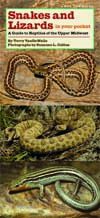
Snakes and Lizards in Your Pocket: A Guide to Reptiles of the Upper Midwest
by Terry VanDeWalle, photographs by Suzanne L. Collins
Bur Oak Guide

Regular Price: $9.95
Sale Price: $6.00

Frogs and Toads in Your Pocket: A Guide to Amphibians of the Upper Midwest
by Terry VanDeWalle, photographs by Suzanne L. Collins
Bur Oak Guide

Regular Price: $9.95
Sale Price: $5.00

Thursday, December 5, 2013

Hot off the Press: SALAMANDERS IN YOUR POCKET, by Terry VanDeWalle

The University of Iowa Press is proud to announce the release of our newest Bur Oak Guide, Salamanders in Your Pocket: A Guide to Caudates of the Upper Midwest, by Terry VanDeWalle and photographs by Suzanne L. Collins.


Terry VanDeWalle provides a complete description of each series as well as distinguishing characteristics for twenty-one subspecies, from the striking orange and yellow spots of the spotted salamander to the lichenlike patches of the green salamander to the prominent rounded head of the mole salamander. He also includes information about the salamanders' range and habitat preferences, from twilight zones of limestone caves and crevices to seepages and spring-fed bogs. Superb photographs by Suzanne Collins make this new guide the perfect companion for outdoor expeditions in all kinds of moist environments.

Wednesday, October 23, 2013

Salamanders: A Closer Look

A new study from Clemson University has found that the examination of the anatomy of the mudskipper fish and tiger salamanders may help explain why fins eventually evolved into limbs.

In Salamanders in Your Pocket: A Guide to Caudates of the Upper Midwest, Terry VanDeWalle provides a complete description of about twenty-five species of salamanders found in the Upper Midwest, as well as distinguishing characteristics for twenty-one subspecies. With stunning photographs by Suzanne L. Collins, this new guide is the perfect companion for outdoor expeditions in all kinds of moist environments. Look for Salamanders in Your Pocket to be released this fall as a Bur Oak guide.